
Hair Is Not a Simple Fiber
A strand of hair looks uniform to the naked eye, but under an electron microscope it reveals a tightly engineered three-layer architecture that researchers compare to a composite material.
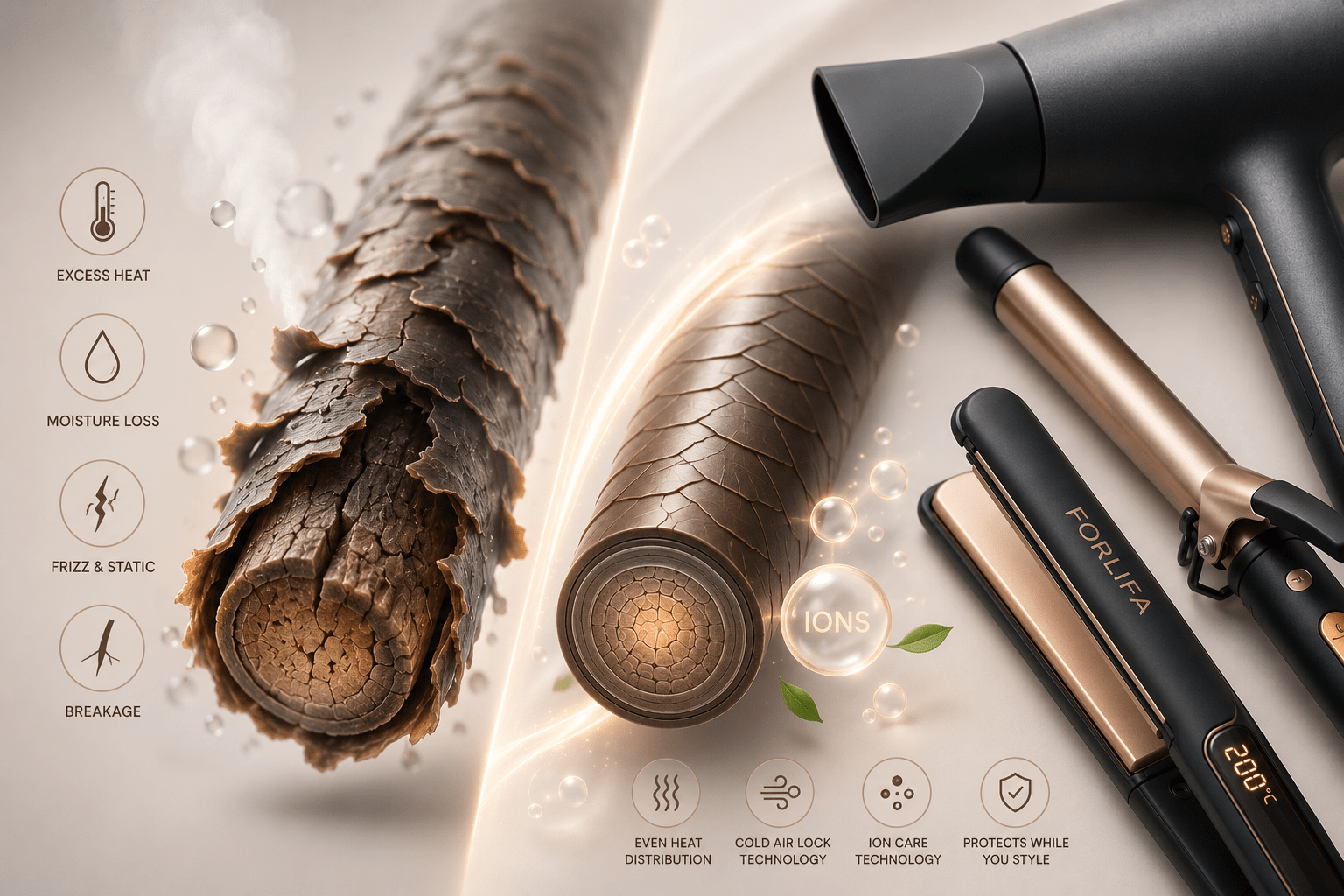
The cuticle forms the outermost surface. It consists of 5 to 10 flat, overlapping cells arranged like roof tiles, each cell roughly 0.5 µm thick and 45–60 µm long. These cells are not randomly stacked — they are anchored in a precise orientation with the free edges pointing toward the tip of the strand. This geometry matters: when something slides along the hair from root to tip, it moves with the cuticle grain. In the other direction, friction increases sharply. Brushing, tangling, and hot tools all interact with this surface constantly.
Beneath the cuticle, the cortex makes up roughly 80–90% of the fiber's total volume. This is where the structural proteins live — tightly wound keratin filaments packed in an ordered lattice, interspersed with melanin granules that give hair its color. The mechanical strength, elasticity, and thermal behavior of hair are all determined primarily by what happens here.
At the center lies the medulla, a loosely organized core that is fully present in coarser hair types but often absent in finer ones. Its primary functional role appears to be thermal: the air gaps within the medulla slow heat transfer inward, providing a modest insulating effect.
The Chemistry That Holds Everything Together
The cortex is not just a mass of protein — it is a hierarchy of interlocking molecular structures, each level of organization contributing to a different physical property.
Individual keratin proteins are long polypeptide chains that fold into a helical shape (the α-helix). Two of these chains twist around each other to form a coiled-coil heterodimer. Four dimers assemble into a tetramer, tetramers stack end-to-end into protofilaments, and eight protofilaments wind together into a keratin intermediate filament roughly 7–10 nm in diameter. These filaments are then embedded in a matrix of keratin-associated proteins (KAPs), of which over 89 distinct variants have been identified, creating a composite structure whose properties shift based on genetic expression.^1^
What binds this entire hierarchy together is a network of chemical bonds operating at different energy levels:
- Disulfide bonds (cystine crosslinks, ~251 kJ/mol) are covalent connections between sulfur atoms on adjacent keratin chains. They are the strongest structural bonds in hair and the primary reason chemically treated hair — where these bonds have been intentionally broken and reformed — behaves so differently from virgin hair. Hair contains approximately 17.5% cystine by amino acid composition.^2^
- Hydrogen bonds (~2–10 kJ/mol) stabilize the α-helical form of keratin. They are far weaker than disulfide bonds, which is precisely why they are the first to respond to heat and moisture. A significant portion of everyday styling — curling, straightening, blow-drying — works by temporarily disrupting hydrogen bonds and allowing the strand to take a new shape as they reform.
- Salt bridges (ionic bonds, ~4–20 kJ/mol) form between oppositely charged amino acid side chains and are sensitive to pH changes. Alkaline chemical treatments disrupt salt bridges as a secondary mechanism alongside disulfide bond cleavage.
Between the cuticle cells and between the cortex cells, a thin film called the cell membrane complex (CMC) acts as an adhesive and structural mediator. The CMC consists of a protein layer sandwiched between two lipid layers, each lipid layer only about 5 nm thick. The outermost lipid coating of the cuticle surface — a fatty acid called 18-methyleicosanoic acid (18-MEA) — is responsible for hair's natural hydrophobicity and low-friction feel. This molecule is among the first casualties of heat damage, chemical processing, and even repeated mechanical friction.^3^
What "Heat Damage" Actually Means, Structurally
The phrase "heat damage" is used loosely, but the underlying mechanisms are specific.
Research using differential scanning calorimetry (DSC) and X-ray diffraction has established clear temperature thresholds for different structural events in dry hair:^4^
At temperatures below 140°C, the primary effect is evaporation of free and loosely bound water. The structural impact on keratin is minimal and largely reversible. Cuticle cells may lift slightly as hydration drops, but they reseal on cooling.
Between 140–190°C, the hydrogen bond network within the α-helix begins to disrupt meaningfully. Keratin chains start transitioning from the α-helical configuration toward the less ordered β-sheet conformation — a change that is not fully reversible under normal conditions. This is the zone where the risk-to-benefit calculation for everyday styling becomes most important: high enough to achieve plastic deformation (which is how curls and straightened styles are formed), but past the threshold of cumulative structural cost.
Above 190°C, melanin granules begin to degrade — the process responsible for heat-induced color fading and brassiness — and the cortex starts to show signs of physical breakdown under prolonged exposure. The absolute denaturation point of dry hair keratin sits near 237°C, which represents a practical engineering boundary: no styling tool should be designed to operate near or above this temperature.^4^
One additional mechanism deserves attention: bubble hair. When a styling tool above approximately 175°C contacts hair that has not been fully dried, residual moisture flash-vaporizes. If the resulting steam pressure exceeds the mechanical yield strength of the cortex, it physically ruptures the fiber from the inside, leaving permanent cavities. The result is hair that appears structurally intact to the eye but is severely weakened at the points of rupture. This is why applying high heat to damp hair produces damage that is qualitatively different — and often more severe — than the same temperature applied to dry hair.^5^
Ethnic Hair Types: Why the Same Tool Behaves Differently
Human hair varies substantially across ethnic backgrounds, and those differences are biologically meaningful rather than cosmetic.
Asian hair (defined largely by the EDAR370A genetic variant) tends toward a circular cross-section with a diameter of 70–100 µm — the largest among the three major types — and the highest cuticle layer count. It grows fastest (~1.3–1.4 cm/month) and has the longest anagen phase, up to seven years, meaning a single strand accumulates more cumulative heat exposure over its lifetime than strands from other groups.^6^
Caucasian hair presents a round-to-oval cross-section at approximately 65 µm diameter, with a moderate cuticle layer count. Its intermediate properties make it most susceptible to mechanical brittleness from repeated thermal cycling.
African hair has a flattened elliptical cross-section, the fewest cuticle layers, and the most stress concentration points due to its helical curl geometry. It requires the gentlest thermal approach of the three types — lower temperatures, reduced mechanical friction, and ideally supplemental moisture to offset the drying effect of heat.^6^
These differences are not just about styling preferences. They are structural realities that should inform how any heat tool is engineered and how temperature recommendations are calibrated.
What This Means for How You Style Your Hair
Understanding hair biology reframes the question around styling tools. The question is not simply "how hot does this tool get?" — it is whether the tool manages temperature with enough precision to stay in the useful styling zone without repeatedly crossing into the structural damage zone.
A few principles follow directly from the research:
Complete drying before high heat is non-negotiable. The bubble hair mechanism is a function of moisture content, not styling duration. Even partially damp hair is at meaningful risk above 150°C.
Faster styling at appropriate temperatures outperforms slower styling at lower temperatures. Prolonged contact — even at moderate heat — accumulates thermal dose. A tool that reaches the right temperature quickly and allows the user to complete a pass efficiently causes less total thermal exposure than one requiring multiple slower passes.
The cooling phase is structurally significant. Hydrogen bonds reform as the strand cools, and the configuration they lock into is determined by the shape the hair holds at the moment of cooling. Passive cooling is slow and uncontrolled; directed cool airflow immediately after heat application can set the reformed bond geometry more precisely and durably — which is the physical principle underlying Forlifa's AirBlow technology.
Negative ions close what heat opens. Heat causes surface charge buildup that lifts cuticle edges and drives frizz. Negative ion emission neutralizes that charge and encourages the cuticle to lie flat, restoring the reflective surface that gives freshly styled hair its visible gloss.
References
1. Bragulla, H.H. & Homberger, D.G. (2009). Structure and functions of keratin proteins in simple, stratified, keratinized and cornified epithelia. Journal of Anatomy, 214(4), 516–559. https://doi.org/10.1111/j.1469-7580.2009.01066.x
2. Yang, F.-C., Zhang, Y. & Rheinstädter, M.C. (2014). The structure of people's hair. PeerJ, 2, e619. https://doi.org/10.7717/peerj.619
3. Weathersby, C. & McMichael, A. (2013). Brazilian keratin hair treatment: a review. Journal of Cosmetic Dermatology, 12(2), 144–148. https://doi.org/10.1111/jocd.12013
4. Wortmann, F.J. & Springob, C. (2001). Investigation of heat-set hair fibers by differential scanning calorimetry. Journal of Cosmetic Science, 52, 367–375.
5. Lee, Y., Kim, Y.D., et al. (2011). Hair shaft damage from heat and drying during hair dryer use: Comparison with air drying. Annals of Dermatology, 23(4), 455–462. https://doi.org/10.5021/ad.2011.23.4.455
6. Franbourg, A., Hallegot, P., Baltenneck, F., Toutain, C. & Leroy, F. (2003). Current research on ethnic hair. Journal of the American Academy of Dermatology, 48(6), S115–S119. https://doi.org/10.1067/mjd.2003.277
This article is part of the Forlifa Knowledge Base — a series of science-backed guides on hair biology, heat styling, and hair care.