
The Complete Curling Iron Buying Guide: What the Marketing Won't Tell You
Most people buy a curling iron twice: once cheap, once right. This guide is designed to save you from the second purchase by explaining what actually separates a damaging $30 tool from one that leaves your hair shinier than when you started.
We'll cover the real science — no fluff — and show you exactly where Forlifa's engineering choices fit into that picture.
Why Your Hair Looks Worse After Styling (And How to Fix It)
When heat is applied to hair, hydrogen bonds inside the hair shaft break and reform around the new shape. That's the mechanism behind every curl and blowout. The problem isn't the heat itself — it's uncontrolled heat.
Temperature spikes cause the cuticle layer to lift unevenly. Lifted cuticles scatter light instead of reflecting it, which is exactly why cheap styling tools leave hair looking dull and frizzy even after a fresh style.
Three components determine whether your tool controls heat well or not:
- The heating element (determines temperature stability and recovery speed)
- The coating (determines how evenly heat transfers to the hair)
- The negative ion system (determines whether the cuticle closes after styling)
Getting all three right is harder than it sounds, which is why price differences between curling irons are rarely about aesthetics alone.
Heating Elements: What Actually Matters for Home Use
The most common heating technology in consumer styling tools is PTC (Positive Temperature Coefficient) — a semiconductor ceramic that self-regulates by increasing electrical resistance as it approaches the set temperature. This makes it inherently safe and consistent for home use.
The quality gap in PTC tools isn't about the technology itself — it's about how well the entire system is tuned. Two tools both using PTC can perform very differently depending on the wattage, the thermal mass of the plate, and how precisely the temperature control circuit is calibrated.
What this means practically: look for tools where the rated temperature range matches your actual hair type, where the wattage is sufficient for consistent heat delivery, and where the coating complements the heating element rather than working against it.
A good home-grade PTC tool, properly engineered, will deliver stable, consistent heat across the styling surface — which is all that's needed to achieve great results without unnecessary damage.
Coatings: What's Actually Touching Your Hair
Bare metal barrels transfer heat unevenly and create friction that pulls at the cuticle. The coating is the interface between the heating element and your hair, and its quality determines both glide and heat distribution.
Basic ceramic coatings smooth surface friction and distribute heat more evenly than raw metal — a meaningful upgrade over entry-level tools.
Advanced protective coatings go further. Tourmaline-infused surfaces release natural negative ions when heated, adding a passive ion effect directly at the contact point. Protein-based coatings deposit keratin-adjacent compounds onto the hair shaft during styling, providing a minor conditioning effect with every pass.
Forlifa's Triple Hair Protection system layers all three — a ceramic glaze base, integrated negative ion output, and a protein shield — working simultaneously at the point of contact. Each addresses a different failure mode: uneven heat distribution, static charge buildup, and surface cuticle damage.
Negative Ions: Real Effect, Real Differences in Quality
Hair carries a positive surface charge, especially after heat exposure. That charge causes individual strands to repel each other — the physical cause of frizz and static flyaways. Negative ions neutralize that charge, help the cuticle lay flat, lock in moisture, and produce the high-gloss finish associated with professional styling.
What separates tools in this area is consistent delivery — not just whether a tool has an ion emitter, but whether it releases ions reliably across the entire styling process. Forlifa's automatic styling tools are independently tested to emit over 3 million ions/cm³ at 3cm distance, with the ion system activating in sync with power-on so protection begins from the first pass.
AirBlow Technology: Why Cold Air Changes Everything
Most styling tools only apply heat. Forlifa's patented AirBlow Technology adds directed cool air during the styling process — sealing the hydrogen bonds in their new configuration before the hair cools passively on its own.
The mechanism: heat breaks the hydrogen bonds (allowing reshaping), and directed cool air immediately locks the new alignment in place. Without this step, bonds continue shifting subtly as the hair cools naturally — which is why many styles lose definition within hours.
The practical result is a 72-hour hold, achieved through thermodynamics rather than product or resins. With AirBlow, full styling typically takes 5–8 minutes, because you're not waiting for gradual air-drying to set the shape.
Forlifa's Styling Tools: Matched to Your Hair Goals
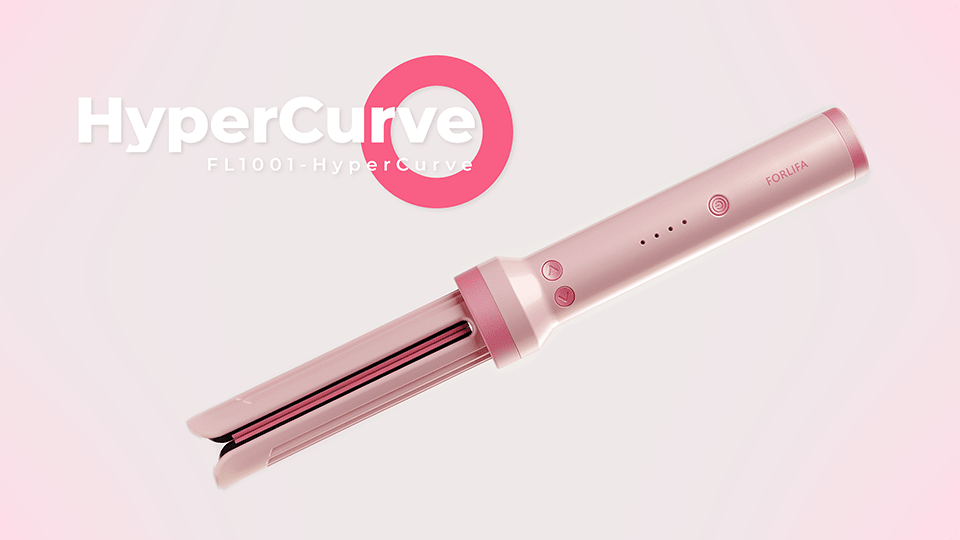
For full styling versatility — Forlifa's flagship automatic curler combines curling, AirBlow cold-air setting, and straightening in a single tool. Three temperature settings (180 / 200 / 220°C) cover most hair types from fine to thick. The Triple Protection coating system runs continuously, and the 360° rotating cord prevents tangling during use. Auto shut-off at 30 minutes.
For blowout volume with a smooth finish — The Pro AirBlow Styling Brush pairs a heated barrel with the same cold-air technology in a brush format. Rounded-tooth design prevents snagging and avoids scalp contact that flat-toothed brushes cause. At 125W, it delivers powerful, consistent heat — and like the curler, its ion system activates on start-up. Three temperature settings (180 / 200 / 220°C), 30-minute auto shut-off.
For bleached, dry, or over-processed hair — The Cold Mist Flat Iron adds moisture directly into the styling process. An ultrasonic mist system (150kHz frequency, 6μm mist particle size) releases a fine cool mist through the plates when closed, helping seal the cuticle and replenish surface hydration lost to heat. Five temperature settings from 280°F to 430°F accommodate a wide range of hair types. Smart activation — mist starts automatically when plates close, stops when opened. Note: designed for 110V use.
For travel and quick touch-ups — The compact AirBlow styling wand brings the same cold-air setting technology in a narrower, lighter format. Dual voltage (100–240V) makes it travel-ready worldwide. Five temperature settings from 285°F to 430°F, 360° rotating cord, and 30-minute auto shut-off.
Quick Reference: Match Tool to Hair Type
| Hair Profile | Best Match |
|---|---|
| Average health, wants versatility | Automatic 3-in-1 curler |
| Wants volume + smooth finish in one pass | Pro AirBlow Styling Brush |
| Bleached, brittle, or very dry hair | Cold Mist Flat Iron |
| Travel / international use / quick touch-ups | Compact AirBlow Styling Wand |
What to Actually Check Before Buying Any Curling Iron
Beyond the Forlifa lineup, here are the hardware questions worth asking about any tool:
- Temperature range and accuracy — Does the stated range match your hair type? Fine hair rarely needs above 180°C; coarser or resistant hair may need up to 220°C or higher.
- Coating composition — Ceramic only, or does it include ion-emitting minerals or protein compounds?
- Ion output — Is a verified test figure cited (e.g., ions/cm³ at a stated distance)? Vague claims are unverifiable.
- Cord rotation — 360° swivel prevents tangling. Non-negotiable for regular use.
- Auto shut-off — A safety baseline, not a premium feature. Expect it on any quality tool.
- Voltage compatibility — If you travel internationally, confirm dual voltage (100–240V) before buying.
The Bottom Line
The difference between a $30 tool and a quality home styling iron isn't markup — it's coating engineering, ion delivery consistency, and whether the tool has been designed to work with the hair's structure rather than simply overpowering it with heat.
If you style frequently, have color-treated or damaged hair, or want results that hold past the same evening, the engineering behind your tool matters. That's the case Forlifa is built on — and why AirBlow Technology is at the core of every product in the lineup.