
Why "Heat Damage" Is Not One Thing
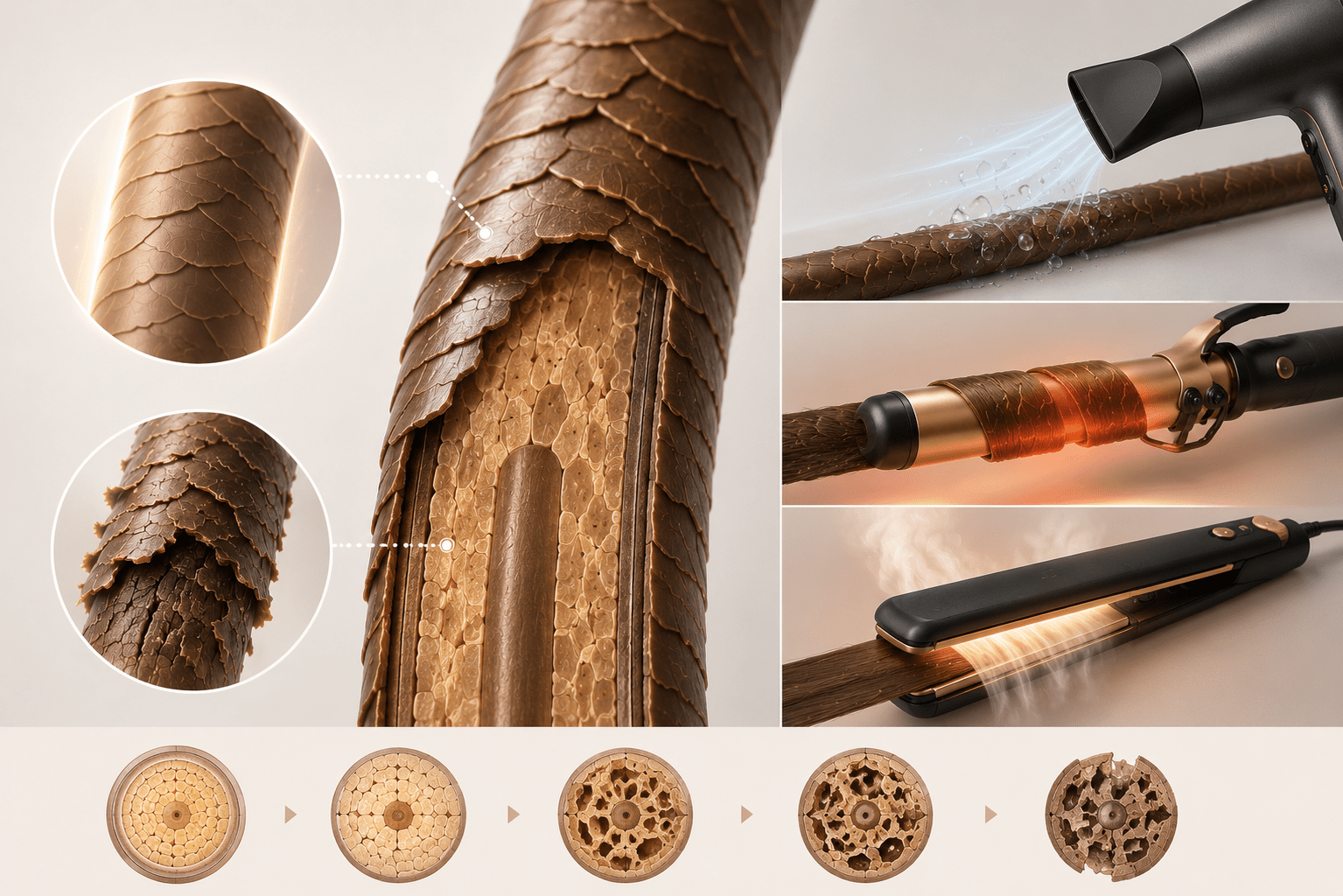
Before looking at individual tools, it helps to recognize that heat affects hair through at least three distinct mechanisms, not one.
The first is hydrogen bond disruption. The α-helical keratin chains that make up the cortex of each hair strand are stabilized by hydrogen bonds — weak, reversible connections that break easily when exposed to heat or water and reform as the fiber cools and dries. This is the mechanism behind every curl, wave, and blowout. It is temporary by design, and in moderate form, it is not damaging in any lasting sense.
The second is irreversible protein denaturation. At higher temperatures, the keratin structure transitions from its α-helical form toward a disordered β-sheet configuration. Unlike hydrogen bond disruption, this transition is not reversible. The fiber's mechanical properties change permanently: it becomes more brittle, less elastic, and more prone to breakage under tension. Research using differential scanning calorimetry places the onset of this process in the 140–155°C range for wet hair and higher for dry hair, with the absolute denaturation threshold of dry hair keratin near 237°C.^1^
The third is surface and membrane degradation. The cuticle's outermost lipid layer — a fatty acid called 18-MEA — and the cell membrane complex (CMC) between cuticle cells are both vulnerable to sustained heat exposure, particularly in combination with mechanical friction. Loss of 18-MEA is what causes hair to feel rough, look dull, and lose its natural hydrophobic behavior.^2^
Each styling tool engages these mechanisms differently. Understanding which mechanism dominates for each tool type is what separates a useful buying decision from a marketing-driven one.
Blow Dryers: The Counterintuitive Research Finding
The prevailing assumption — that air-drying is gentler than blow-drying — is not supported by the biophysical evidence. A landmark 2011 study published in the Annals of Dermatology by Lee et al. compared hair dried under multiple conditions and found that natural air-drying actually produced measurable CMC damage.^3^
The reason is mechanical and chemical rather than thermal. When hair remains saturated for extended periods — the two or more hours required for air-drying — the sustained osmotic stress and repeated swelling-and-contraction cycles degrade the CMC's lipid layers, even without any heat input. The protein structures within the CMC expand and weaken over time simply from prolonged hydration.
In the same study, hair dried with a blow dryer held at 15 cm distance (producing a surface temperature of approximately 47°C) showed the least total damage — less even than air-dried hair. The cuticle structure was preserved, the CMC remained intact, and drying time was reduced to about 60 seconds. Only when the dryer was brought within 5 cm of the hair — producing surface temperatures around 95°C — did thermal damage become apparent: cuticle perforation, outermost layer destruction, and early melanin degradation.
The practical takeaway is not that heat is harmless, but that distance and temperature control matter more than whether a dryer is used at all. A tool that maintains a consistent moderate temperature and can be used efficiently at appropriate distance is, by the evidence, preferable to extended air exposure.
Curling Irons: Managing Uneven Heat Distribution
Curling irons present a specific thermal challenge that flat irons do not: when hair is wrapped around a cylindrical barrel, the strands touching the barrel surface receive direct conductive heat while the outer layers of the wrapped bundle receive primarily radiant heat. This creates a temperature gradient within the hair bundle that can be significant, particularly with thicker sections.
The practical consequence is that users often compensate by holding the iron longer or repeating passes — both of which increase total thermal dose substantially. A barrel that achieves genuinely even far-infrared (FIR) emission across its surface reduces this gradient, allowing effective styling in a single controlled pass rather than requiring repetition to reach the outer layers.
Barrel coating also affects the mechanical interaction at the surface. A smooth, low-friction surface reduces the lateral shear force on the cuticle during wrapping and unwrapping. Tourmaline-composite coatings add passive negative ion emission when heated, neutralizing the surface charge buildup that lifts cuticle edges — a particularly useful property given the wrapping motion inherent in curling.
Timing is a frequently underestimated variable. The difference between 5 seconds and 12 seconds of barrel contact at 180°C represents a meaningfully different thermal dose to the cortex. A tool with an integrated timing mechanism — even a simple vibration alert — removes the guesswork and helps users stay in the productive styling zone rather than drifting into the damage zone.
Flat Irons: The Highest-Contact Category
Of the major tool categories, flat irons concentrate the highest heat intensity in the smallest contact area. The plates apply both direct conductive heat and compressive mechanical force simultaneously, which means the relevant damage mechanisms — protein denaturation, CMC disruption, and surface friction — all operate at once.
Plate material composition is the primary engineering variable that determines how a flat iron interacts with hair at a structural level:
Ceramic plates transfer heat via far-infrared radiation rather than pure surface conduction. This produces a more even temperature distribution across the hair bundle, including moderate penetration toward the cortex, rather than concentrating heat at the cuticle surface. For fine, chemically processed, or bleached hair — where the cuticle is already compromised — ceramic's gentler, more even heat transfer is the better-matched choice.^4^
Titanium plates conduct heat extremely efficiently and reach operating temperature quickly, with minimal thermal loss during use. The faster heat-up means less idle warm-up time at high temperatures, and the consistent heat delivery reduces the need for slow passes. The tradeoff is that titanium's high thermal conductivity can amplify surface heat spikes if temperature regulation is imprecise. Titanium is best suited to coarse or highly resistant hair that genuinely requires higher thermal input.
Tourmaline composite plates layer negative ion emission on top of the base coating. This has a specific mechanical effect: negative ions drive the cuticle to lay flat after heat exposure, reducing the surface roughness that causes frizz and reducing the friction of subsequent passes. For hair that responds strongly to static and humidity, this combination outperforms ceramic or titanium alone.
Steam flat irons represent a distinct category within this group. Rather than relying on heat alone to reorganize hydrogen bonds, steam delivers controlled moisture vapor directly into the styling zone. Water vapor penetrates the cortex and acts as a plasticizer — it softens the hydrogen bond network so that reshaping occurs at lower temperatures (typically 150–170°C versus the 175–200°C often needed for dry flat ironing). Steam also forms a thin hydrodynamic film between the plate surface and the cuticle cells, reducing the friction coefficient substantially.^5^ The combined result is effective styling with less total thermal input, which is measurably associated with reduced breakage compared to conventional dry flat ironing.
Negative Ions: What They Actually Do
Negative ion claims appear across nearly every category of styling tool, but the mechanism is specific and worth understanding precisely.
Heat styling generates a positive electrostatic charge on the hair surface. This charge is what causes individual strands to repel each other, lift away from the scalp, and resist lying flat — the physical signature of frizz and static. Negative ion emission neutralizes this surface charge, allowing strands to realign, cuticle edges to close, and the hair's surface to become smooth enough to reflect light coherently.
The effectiveness of ion emission depends on output consistency rather than peak capability. An ion emitter that delivers reliably across the full styling session — not just in brief bursts — maintains the charge-neutralizing environment throughout. Independently verified ion output figures (expressed as ions/cm³ at a specified distance) are the only meaningful way to compare tools in this area; descriptive claims without measurement data are not evaluable.
Applying the Science: A Tool Selection Framework
The research supports a few practical principles that cut across all tool categories:
Match temperature to hair type, not habit. Fine or chemically treated hair has a compromised cuticle with fewer protective layers. It genuinely requires lower temperatures than the same tool used on coarse or virgin hair. Tools with precise, graduated temperature settings — rather than simple low/medium/high — allow this calibration.
Prioritize even heat distribution over maximum temperature. The gradient between the hottest and coolest points on a styling surface or barrel is as important as the absolute temperature. Uneven heat means some sections are overexposed while others are understyled, which drives repeated passes and higher cumulative dose.
Complete the bond-setting phase actively. Hydrogen bonds reformed around a new shape are still mobile until the hair fully cools. Passive cooling is slow and allows drift from the intended configuration — which is why styles often relax within hours. Directed airflow immediately after heat application, while the hair is still shaped, locks the reformed bond geometry in place durably. This is the physical basis for Forlifa's AirBlow Technology across its curling and styling lineup.
Account for moisture before applying high heat. The flash-vaporization mechanism that causes bubble hair — a condition where residual moisture in damp hair converts to steam under the plate, physically rupturing the cortex — activates at surface temperatures above approximately 175°C. Thorough drying before contact with any high-heat tool is not a precaution; it is a structural requirement.
References
1. Wortmann, F.J. & Springob, C. (2001). Investigation of heat-set hair fibers by differential scanning calorimetry. Journal of Cosmetic Science, 52, 367–375. https://pubmed.ncbi.nlm.nih.gov/11715984/
2. Robbins, C.R. (2012). Chemical and Physical Behavior of Human Hair (5th ed.). Springer. https://doi.org/10.1007/978-3-642-25611-0
3. Lee, Y., Kim, Y.D., Pi, L.Q., et al. (2011). Hair shaft damage from heat and drying during hair dryer use: comparison with air drying. Annals of Dermatology, 23(4), 455–462. https://doi.org/10.5021/ad.2011.23.4.455
4. Fernández, E., Barba, C., Alonso, C., et al. (2012). Thermal analysis of human hair. Journal of Thermal Analysis and Calorimetry, 108(3), 1159–1166. https://doi.org/10.1007/s10973-012-2454-9
5. Gama, R.M., et al. (2020). Effects of steam on hair structure and mechanics. International Journal of Cosmetic Science, 42(1), 102–110. https://doi.org/10.1111/ics.12598
6. Yang, F.-C., Zhang, Y. & Rheinstädter, M.C. (2014). The structure of people's hair. PeerJ, 2, e619. https://doi.org/10.7717/peerj.619
Part of the Forlifa Knowledge Base. Articles in this series are grounded in peer-reviewed dermatology, materials science, and cosmetic science literature. Product references reflect engineering principles described in the research cited.