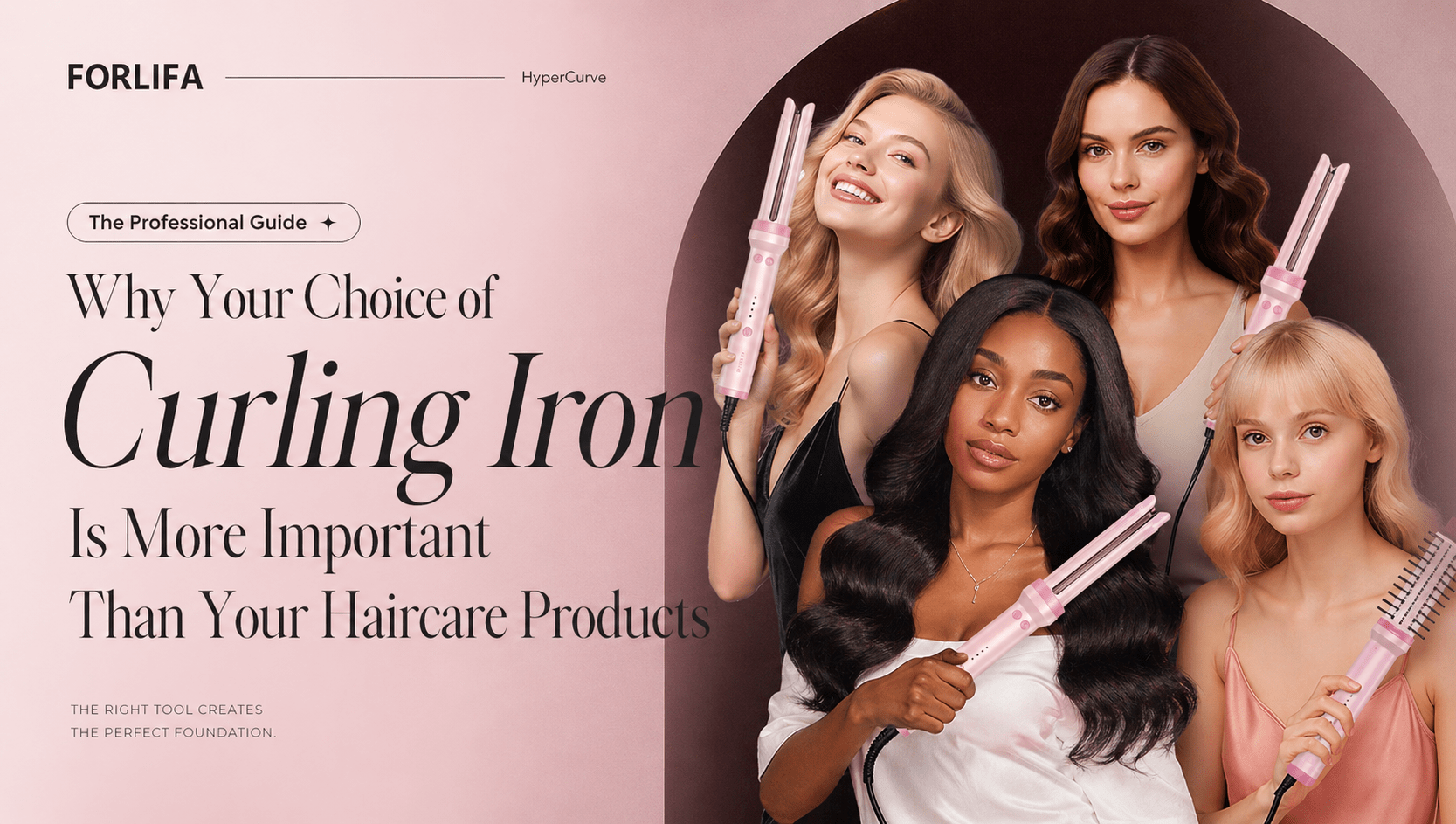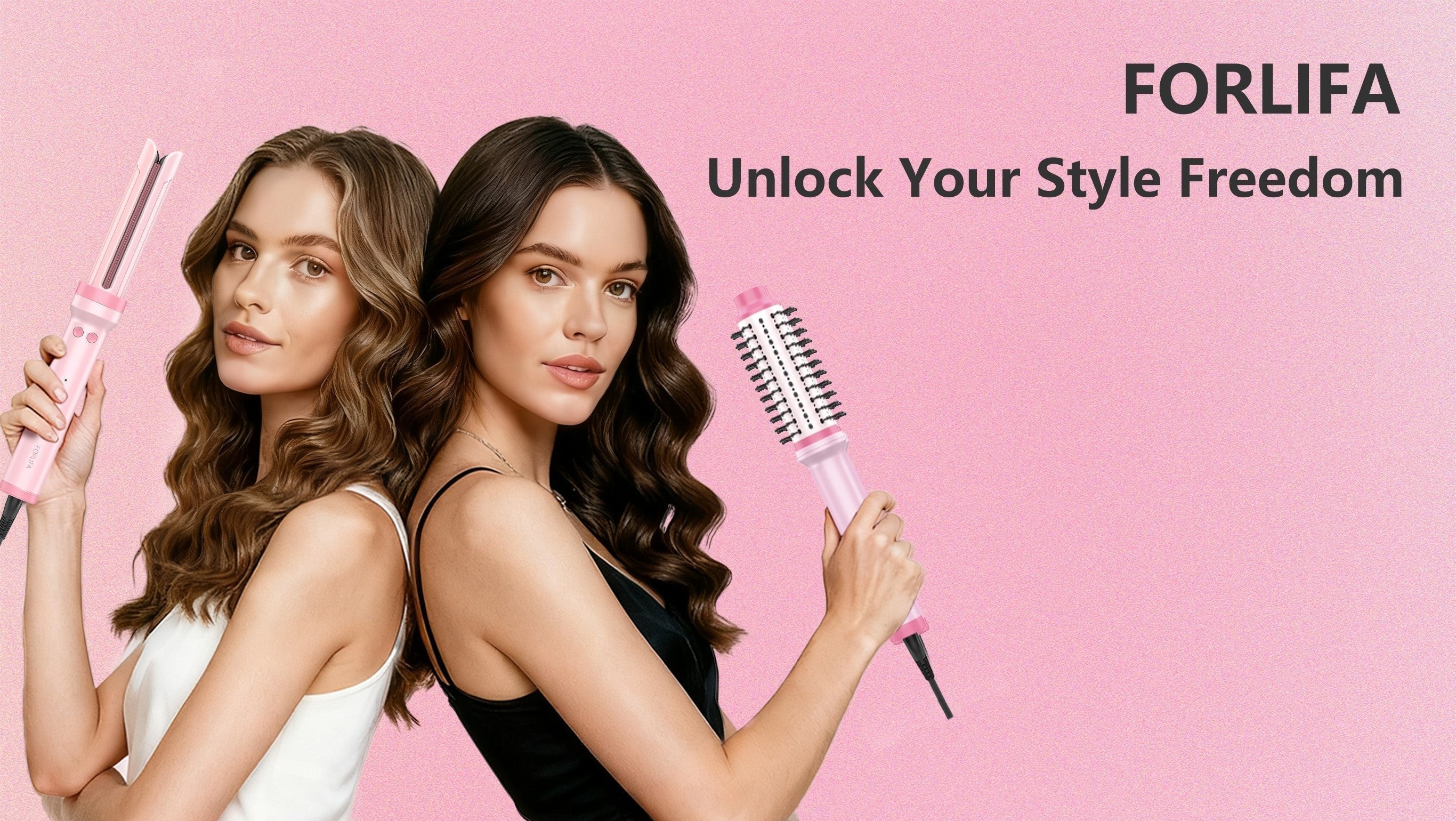

You've probably noticed it: you spend twenty minutes curling your hair, walk out the door looking great, and by lunchtime the style has dropped. Or worse — after a few months of regular styling, your hair feels thinner, breaks more easily, and loses its natural shine. The tool is doing something, just not entirely what you hoped.
The problem isn't that heat styling is inherently damaging. The problem is that most tools apply heat without any mechanism to control what happens next. Understanding that gap is the key to understanding why the Forlifa HyperCurve Pro was engineered the way it was.
What Heat Actually Does to Your Hair
When a hot barrel contacts your hair shaft, it breaks the hydrogen bonds that hold the keratin structure in shape. That's the useful part — it's what allows your hair to take on a new form. But hydrogen bonds don't care about your styling intentions. Without an intervention, they'll simply continue shifting as the strand cools on its own, which is why styles fade and why repeated heat exposure causes cumulative structural wear.
Temperature matters more than most people realize. Research in dermatology and cosmetic science has mapped out clear damage thresholds: below 140°C, effects on keratin are largely reversible. Between 140–190°C, hydrogen bond networks begin to rupture in ways that don't fully repair themselves. Above 190°C, melanin degradation starts — the process that causes color-treated hair to turn brassy — and cortex breakdown begins. Near 237°C, keratin reaches its denaturation point, which is a threshold no well-engineered styling tool should ever approach.
The HyperCurve Pro's three temperature settings — 180°C, 200°C, and 220°C — are deliberately mapped to hair types rather than arbitrary numbers. Fine or previously damaged hair sits safely in the lower range. Coarse or resistant hair can use the upper setting while still staying well below the irreversible denaturation zone.
The Case for Cold Air: AirBlow Technology Explained
Most curling irons stop at the heating stage. The Forlifa HyperCurve Pro adds a second, mechanically distinct step: directed cool air delivered immediately after the curl is formed.
The physics behind this matters. Heat breaks hydrogen bonds and allows reshaping. But those bonds remain in a transitional state until the hair cools — and passive cooling is slow and uneven. During that window, the curl is still mobile, which is why styles lose definition over hours rather than staying crisp.
AirBlow Technology solves this by sealing the newly formed bonds while the shape is still exact. The result is a style that holds for up to 72 hours — not because product or resin is holding it in place, but because the structural reset was completed properly. Full styling typically takes 5 to 8 minutes with this method, because you're not waiting for ambient air to finish the job.
Triple Protection: What's Actually Touching Your Hair
The barrel coating isn't cosmetic — it's the primary interface between your tool and your hair, and its composition determines both glide quality and heat distribution.
The HyperCurve Pro uses a three-layer approach. The ceramic glaze base distributes heat evenly across the styling surface, eliminating the hot spots that cause uneven curls and localized damage. The tourmaline-infused layer emits negative ions when heated; these ions neutralize the positive surface charge that builds up on hair during heat exposure and is the direct physical cause of frizz and static. The outer protein shield deposits keratin-adjacent compounds during styling, providing a minor conditioning effect with every pass rather than stripping the surface.
Independent testing confirms the ion output at over 3 million ions per cubic centimeter measured at 3 cm distance, with the ion system activating simultaneously with the heating element so protection begins from the first contact.
Performance Specifications: What the Lab Data Shows
The HyperCurve Pro passed all 11 items in reliability lab testing (Test No. ZZR2025566), including 10,000 wire flex cycles with no copper fracture, insulation resistance above 4MΩ at 1000V, high-temperature operation at 45°C for 2 continuous hours, low-temperature function at -20°C, and 5,000 simulated styling cycles with no paint delamination or surface defect. The testing also confirmed structural integrity under 35 lbs of cord load for 60 seconds — a measurement of real-world durability at the most vulnerable stress point of any corded appliance.
A separate packaging reliability test (ZZR2025794) covering carton vibration at 240 CPM across three axes and a 60.96 cm drop sequence confirmed that the product arrives undamaged through normal shipping conditions, including corner and edge impacts.
How the HyperCurve Pro Fits Into the Forlifa Lineup
Forlifa builds each tool in its range around a specific use case rather than offering one product in multiple colors. Understanding where the HyperCurve Pro sits helps identify whether it's the right match for your styling habits.
The HyperCurve Pro is the versatility choice — automatic curling, cold-air setting, and straightening in a single tool. It's designed for people who want one high-quality instrument that handles multiple styling needs without compromise.
The AirCurl Pro (0.6-inch compact styler) covers similar temperature range in a narrower barrel format, with its own AirBlow cold-air system and an airflow output of at least 0.8 m/s. It's better suited for tighter curl patterns or travel use, and at 307 grams it's meaningfully lighter than full-sized tools.
The Hyper Steam (professional flat iron) is a dedicated straightening tool at 72W with five temperature settings from 140°C to 220°C. It includes a steam function — which activates the hydrogen-bond plasticization mechanism discussed earlier, allowing the iron to achieve smooth results at slightly lower temperatures by supplementing heat with controlled moisture. The 30-minute auto shut-off is standard across the Forlifa range.
The Pro AirBlow Brush (styling brush) operates differently from the barrel-based tools. At 125W with a motor running at 9,400 RPM and a minimum airflow of 0.4 m/s, it combines heat and air movement in a round-brush format — ideal for blow-dry volume and smoothness in a single pass. Negative ion output is independently verified at 3 million ions/cm³ minimum, with three heat settings from 180°C to 200°C.
What to Look for When Buying Any Heat Styling Tool
Whether you're evaluating the HyperCurve Pro or any other tool, these are the technical factors that separate tools that work with your hair's structure from those that simply overpower it:
Temperature precision.
A stated temperature range is only useful if the tool actually maintains it under load. Look for verified performance data rather than marketing claims.
Coating composition.
Bare metal barrels distribute heat unevenly and create friction. Ceramic bases improve both; tourmaline integration adds passive ion output; protein coatings add surface conditioning. A tool that combines all three provides layered protection rather than relying on a single mechanism.
Ion output verification.
Ion emitters are common claims and difficult to evaluate without test data. A specific figure — ions per cubic centimeter at a stated distance — is verifiable. Vague language like "ionic technology" is not.
Post-heat mechanism.
This is the most underrated factor in styling performance. A tool that only applies heat and stops leaves the style completion to passive cooling. A tool with directed cold air completes the bond-setting process intentionally.
Safety baseline.
Auto shut-off at 30 minutes, 360° cord rotation to prevent tangling, and dual voltage (100–240V) for international use are worth confirming before purchase.
The Bottom Line
Hair damage from styling tools is a real and well-documented phenomenon — but it's not inevitable. The research consistently shows that the primary variables are temperature control, the condition of the heat-transfer surface, and what happens during the cooling phase. A tool engineered to manage all three can deliver professional-quality results while leaving the hair's structural integrity intact.
The Forlifa HyperCurve Pro was built around that principle. AirBlow Technology addresses the cooling phase that most tools ignore. The Triple Protection coating system works at the contact point where heat transfer and surface friction interact. And the temperature architecture keeps all settings in a range that allows effective styling without crossing into irreversible damage territory.
If you style your hair regularly — especially if it's color-treated, fine, or shows signs of previous heat damage — the engineering behind your tool is not a marginal concern. It's the difference between styling that works for your hair and styling that works against it.