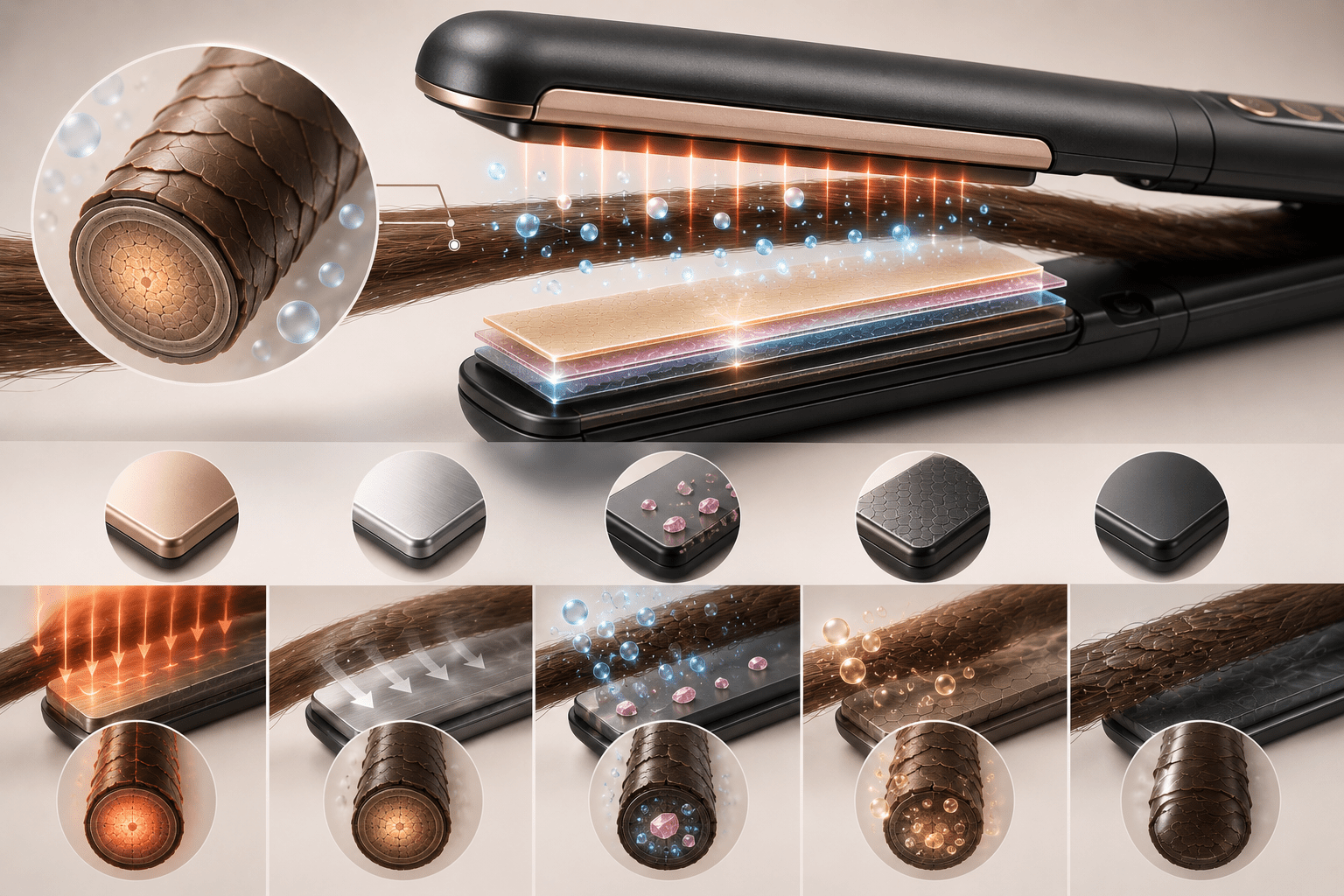

Product pages for hair styling tools are full of numbers: ion concentrations, temperature accuracy claims, tensile strength retention percentages, gloss improvements. Some of these figures come from rigorous, independently verified testing against internationally recognized standards. Others are internal measurements conducted under unspecified conditions using methodologies that cannot be independently replicated.
Knowing which is which — and understanding what the underlying tests actually measure — is the difference between evaluating a tool on real evidence and evaluating it on well-packaged assertions. This article breaks down the testing ecosystem for hair styling tools: the structural damage methods, the thermodynamic thresholds that matter for safety, the optical measurement systems behind shine claims, and the international standards that govern electrical and thermal safety.
How Hair Damage Is Actually Measured
Before discussing what numbers to trust, it helps to understand how hair damage assessment works at a technical level. There are three primary methodologies used in cosmetic science and engineering research.
Microscopic morphology grading examines the cuticle surface and cortex using scanning electron microscopy (SEM) or transmission electron microscopy (TEM). The most widely cited grading system for research purposes, developed by Kim et al., uses a five-point scale (0–4) that runs from completely intact, overlapping cuticle cells at grade 0 to full cortex exposure at grade 4. A more sensitive extension by Lee et al. expands this to a 12-point scale, capable of distinguishing minor protective differences between advanced coating formulations — particularly relevant for evaluating the incremental benefit of nano-coating technologies where the differences under a standard four-point scale would be statistically invisible.^1^
More recently, AI-based image analysis using convolutional neural networks (CNN architectures, including RCSAN-Net) has been applied to automating hair damage classification at approximately 90% accuracy compared to expert human graders.^1^ This development matters for product development cycles: automated microscopy assessment allows larger sample sizes and faster iteration than manual SEM grading, which historically constrained how many test conditions could be evaluated in a single study.
Mechanical tensile testing measures how heat treatment changes the fiber's physical properties. Single-fiber tensile testing (using automated systems such as the Dia-Stron MTT175) measures peak stress at break (σ) and the variability coefficient (ξ) across a population of fibers before and after a defined number of styling passes.^2^ The ξ variability coefficient is particularly informative: it captures not just average strength change but the consistency of the fiber population after treatment. High variability after heat treatment suggests some fibers were significantly weakened while others were relatively preserved — a pattern associated with uneven heat distribution or hot spots.
Standardized test protocols for product claims typically simulate 50–100 styling passes before measurement. A tool supporting a "low damage" claim should demonstrate tensile strength retention above 90% after this cycle. A "moisture lock" claim should be supported by thermogravimetric analysis (TGA) showing moisture loss below 5% compared to a control.^2^
Optical gloss measurement uses polarized light systems to quantify the light-reflection properties of styled hair. The SAMBA system (Bossa Nova Technologies) separates specular reflection — the sharp, directed light band that produces visible shine from a smooth, closed cuticle — from diffuse reflection, which is the scattered light produced by surface irregularities and open cuticle scales.^3^ The ratio between these two components is mathematically formalized as the BNT (Brilliance/Normalized Transmitted) coefficient. A verified shine claim should cite BNT improvement data with a specific percentage; claims of "enhanced shine" without an optical measurement methodology behind them are not independently evaluable.
The Denaturation Thresholds That Define Safety Boundaries
The thermodynamic limits for hair safety under heat exposure are established by differential scanning calorimetry (DSC) — a technique that measures the heat flow required to drive phase transitions in the fiber as temperature is ramped upward.
The critical finding from DSC research, as covered in detail in our article on heat damage mechanisms, is that the denaturation temperature of keratin is not fixed — it is a function of moisture content. Wet or hydrated hair shows a primary denaturation peak in the range of 150–160°C.^4^ Dry hair (at ambient humidity, with 10–15% residual moisture) shows its primary denaturation peak in the range of 228–240°C.
The engineering implication of the wet-hair threshold is absolute: no heat tool should contact hair that has not been fully dried. At temperatures above the wet-state denaturation threshold, residual moisture in the fiber flash-vaporizes under the plate, generating internal steam pressure that physically ruptures the cortex — a permanent structural failure that no coating, protein treatment, or post-styling care product can repair. Complete drying is a structural prerequisite, not a styling preference.
For dry hair, the DSC data establishes the denaturation zone rather than a sharp line. Styling that consistently remains below 180–185°C operates with a substantial margin below the dry-state onset. Styling in the 185–220°C range — appropriate for coarse, resistant hair that requires more thermal input to reach its glass transition zone — uses more of that margin and correspondingly demands more precise temperature stability and shorter contact times. The relevant engineering goal is not to minimize temperature in isolation but to deliver the minimum effective temperature with maximum consistency, keeping total thermal dose as low as possible for the intended styling outcome.
What IEC Standards Actually Require
The International Electrotechnical Commission maintains two standards directly relevant to hair styling tools, and understanding what each covers helps distinguish genuine compliance from nominal certification.
IEC 60335-2-23 is the safety standard for skin and hair care appliances. Its requirements are not performance-related — they define the physical safety baseline that any compliant tool must meet.^5^ Key provisions include:
Thermal isolation between the heating element and the handle — the user-contact surface must maintain a safe temperature even during sustained operation at maximum heat.
Non-self-resetting thermal cut-out. This requirement is less visible than it sounds but directly relevant to long-term use safety: if a tool's overheat protection triggers, it must require deliberate manual reset rather than automatically resuming operation when the temperature drops. This prevents a thermal runaway cycle where a fault causes overheating, the cut-out trips, the tool cools slightly and resets automatically, overheats again, and repeats. Non-self-resetting design ensures a fault requires user acknowledgment before the tool operates again.
Flame retardancy for the housing material — IEC 60335-2-23 requires the external housing to use UL94 V-0 or equivalent flame-retardant grade engineering polymers (typically PC/ABS compounds).^5^ This is not visible in normal use, but it determines how the tool behaves in an overheating or ignition scenario.
IEC 61855:2022 is the performance standard — the specification that governs how hair dryer aerodynamic and thermal performance is measured and reported.^6^ Two provisions are particularly relevant to consumer claims:
Wind speed measurement must be conducted at a fixed point 100 mm horizontally from the outlet. This standardizes the measurement condition so that airflow figures from different manufacturers are at least nominally comparable.
Ion arrival rate specification requires that negative ion concentration be measured at 300 mm from the outlet — not at the generator itself, not adjacent to the tool, but at a standardized distance representing realistic use conditions. This provision specifically addresses "nominal concentration" reporting, where manufacturers cite the ion output of the generator rather than the ion concentration actually delivered to the hair during use. Tools tested to IEC 61855:2022 report figures that are directly relevant to the user experience; tools citing generator-level figures without distance specification are reporting a different — and higher — number than what reaches the hair.
The Forlifa HyperCurve Pro carries cTUVus certification (TÜV Rheinland, test certificate CN25F5WS) confirming compliance with both UL 859 and North American electrical safety requirements.^7^ The ion output figures cited for the HyperCurve Pro (1.1 billion ions across the active emission zone) are supported by independent laboratory test documentation (report 25062018617SAF-2), providing traceability for the claim.
The HPF Framework: A Developing Standard Worth Understanding
One emerging framework in hair care science is the Hair Protection Factor (HPF) — a calibrated 15-point scale that borrows the conceptual structure of SPF (sun protection factor) to quantify how effectively a styling regimen or tool coating protects the fiber from heat-induced variability.^3^
The HPF scale is calculated from the ξ variability coefficient measured in tensile testing: a tool or treatment that preserves fiber-to-fiber consistency after heat exposure scores toward the high end (HPF 15); one that produces high variability in post-treatment fiber strength scores toward the low end. The logic is the same as SPF — a higher number indicates greater protection, defined consistently through a reproducible measurement.
HPF is not yet an industry-standard designation on the same level as IEC compliance. It is a research framework under development that provides a useful structure for comparing product claims, but published HPF figures currently appear in academic and white-paper contexts rather than on product labeling. What it offers consumers is a conceptual framework: when a product claims to reduce heat damage, ask what measurement methodology supports that claim, what the comparison baseline was, and whether the testing protocol is independently verifiable or internally conducted.
The trend in hair care testing is toward precisely this kind of quantified, reproducible evidence base — moving away from categorical claims ("protects against damage") toward measurement-backed assertions ("tensile strength retention >90% after 100 passes, verified by independent single-fiber tensile testing"). As test methodologies become more standardized, the claims that can be meaningfully compared will expand accordingly.
Reading a Test Claim: A Practical Checklist
For any performance claim on a styling tool, these questions determine whether the figure is evaluable:
For temperature accuracy:
Is a specific tolerance cited (e.g., ±2°C)? Is the measurement methodology specified (thermocouple at plate surface, measured under load)? Temperature accuracy at no-load startup tells you little; temperature stability during sustained use is the relevant figure.
For ion output:
Is a concentration figure cited in ions/cm³ or ions/m³? At what distance from the tool was it measured? A figure without a distance specification is not comparable to one with a distance. IEC 61855:2022-compliant measurement is at 300 mm from the outlet.
For damage protection claims:
What test protocol was used? How many styling passes were simulated? What was the comparison — no heat, a competitor tool, a tool without the protective feature? Tensile strength retention above 90% after 50–100 passes, against a heat-only control, is a meaningful claim. "Reduces damage" without a protocol is not.
For shine claims:
Is a BNT coefficient figure cited? Is the measurement system identified (SAMBA or equivalent polarized-light quantification)? "Boosts shine" as a standalone claim has no measurement behind it.
For electrical safety:
Does the tool carry third-party certification — cTUVus, CE, ETL, or equivalent — from a recognized independent testing organization? Self-certification and third-party certification are not equivalent. The certification document should be traceable to a specific test report, not just a logo on the packaging.
The tools that hold up to these questions are the ones where the engineering investment went into performance rather than just presentation. That is the distinction worth making when the claims start to look similar across price points.
References
1. Lee, Y., Kim, Y.D., et al. (2011). Hair shaft damage from heat and drying during hair dryer use. Annals of Dermatology, 23(4), 455–462. https://doi.org/10.5021/ad.2011.23.4.455
2. Breakspear, S., Smith, J.R. & Luengo, G. (2005). Effect of the covalently linked fatty acid 18-MEA on the nanotribology of hair's outermost surface. Journal of Structural Biology, 149(3), 235–242. https://doi.org/10.1016/j.jsb.2004.10.003
3. TRI Princeton (2021). Hair protection factor and optical assessment methodology. TRI Princeton Technical Reports. https://www.triprinceton.org
4. Wortmann, F.J., Springob, C. & Sendelbach, G. (2002). Investigations of cosmetically treated human hair by DSC. Journal of Cosmetic Science, 53, 219–228. https://pubmed.ncbi.nlm.nih.gov/12151927/
5. IEC 60335-2-23:2016+AMD1:2019. Safety of household and similar electrical appliances — Part 2-23: Particular requirements for appliances for skin or hair care. International Electrotechnical Commission. https://webstore.iec.ch/publication/60614
6. IEC 61855:2022. Performance measurement methods for household hair care appliances. International Electrotechnical Commission. https://webstore.iec.ch/publication/68841
7. TÜV Rheinland. cTUVus Certification for North American Market. https://www.tuv.com/usa/en/ctuvus.html
Part of the Forlifa Knowledge Base. See also: [The Science of Heat Damage] · [What's Actually Touching Your Hair: Coating Materials Science] · [Hair Type & Temperature Guide]