
Most product descriptions treat coating as a single variable ("ceramic" or "titanium") when it is actually a system. Understanding what each component of that system does, how different materials compare quantitatively, and where the technology is heading gives you a more reliable basis for evaluating tools than marketing language alone provides.
The Core Problem: What Bare Metal Does to Hair
The baseline case — bare metal in contact with hair — is instructive for understanding why coating matters at all.
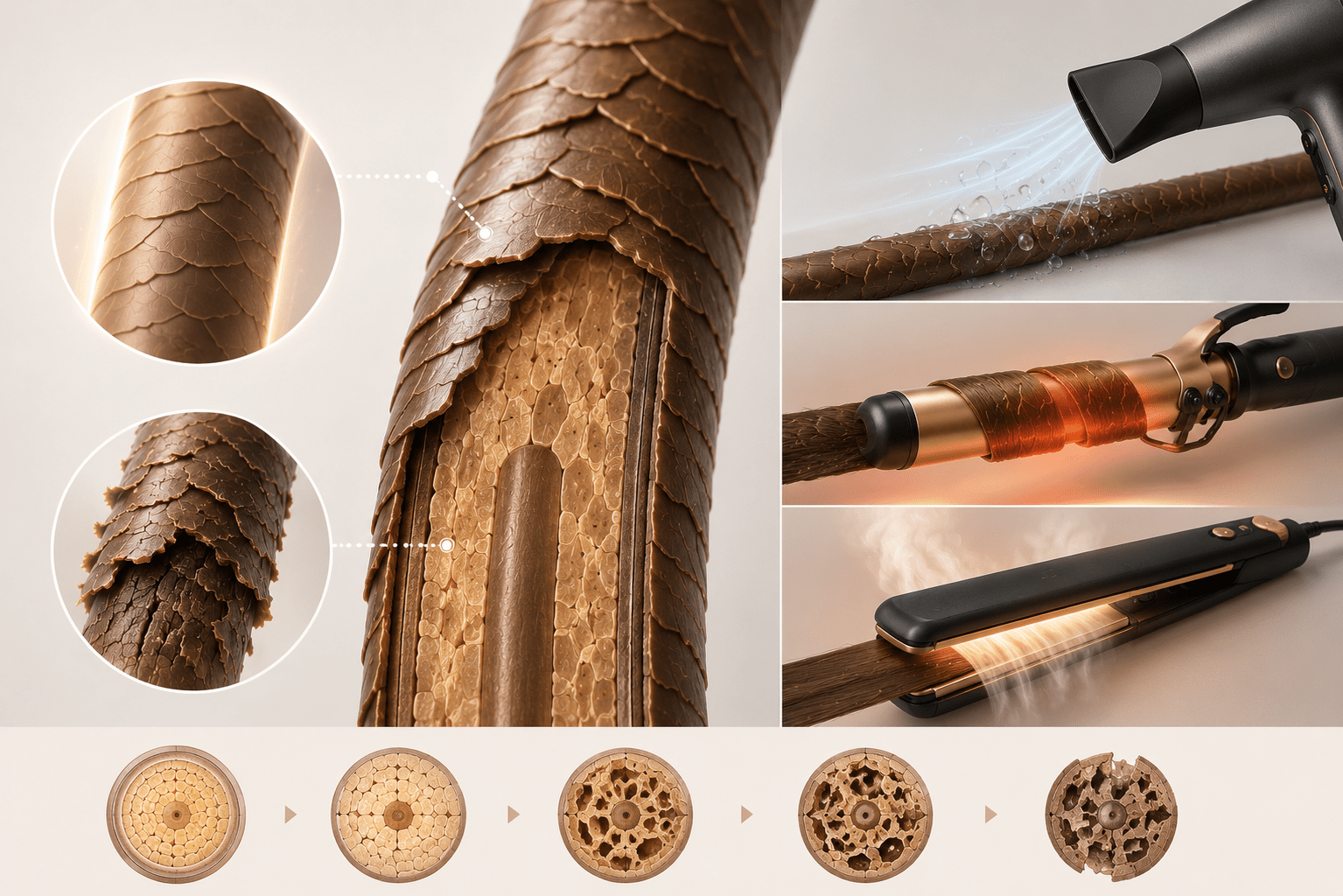
Metal surfaces transfer heat through direct conduction. The thermal conductivity is high, which means the contact point heats rapidly, but the distribution across the surface is uneven. Localized hot spots develop where the metal contacts the hair most directly, creating temperature variation within a single pass. In practice, this means some sections of hair receive more heat than others from the identical tool at the identical setting — some overexposed, some underexposed — driving repeated passes to achieve even results and increasing cumulative thermal dose in the process.
The second problem is friction. Hair cuticle cells are arranged with their free edges pointing toward the tip of the strand, like roof tiles. Mechanical contact against this geometry — particularly in the non-smooth direction — generates shear forces on individual scale edges. Bare metal has a coefficient of friction (COF) against hair that is sufficient to lift and damage cuticle scales mechanically, independently of whatever thermal damage is occurring simultaneously. The two damage vectors compound rather than operate in isolation.^1^
A well-engineered coating addresses both problems and adds a third layer of active protection.
Ceramic: Even Heat, Inside-Out Delivery
Ceramic coatings address the thermal uniformity problem through two mechanisms. First, ceramic materials have lower thermal conductivity than metals, which slows the rate of heat transfer but distributes it more evenly across the plate surface. Second, ceramic emits far-infrared (FIR) radiation — a wavelength of electromagnetic energy that penetrates the cuticle and heats the cortex from within rather than from the surface alone.
The practical consequence of far-infrared delivery is that the temperature gradient between the outer cuticle and the inner cortex is reduced. With purely conductive heating, the outer surface reaches the target temperature first while the cortex lags — which means users often extend contact time or increase temperature to ensure the cortex reaches the styling zone, at the cost of overexposing the cuticle surface. FIR-based heating reduces this lag.
Thermal field measurements of high-quality ceramic plates show surface temperature variation (ΔT) of ±1.7°C or less across the plate area — effectively eliminating hot spots under controlled conditions.^2^ This uniformity has a direct structural benefit: it reduces the variance in thermal dose received by different sections of hair in a single pass, which is the mechanism behind ceramic's reputation for gentler results on fine or processed hair.
The limitation of ceramic is durability. Ceramic glaze coatings have a pencil hardness rating in the 5H–7H range and a coefficient of friction against hair in the 0.15–0.22 range — meaningfully lower than bare metal, but not the lowest available. Coating integrity under repeated high-temperature cycling determines functional lifespan, and lower-grade ceramic coatings can develop micro-cracks over time that reintroduce both the friction and thermal uniformity problems they were designed to solve. Coating thickness and ceramic grade matter substantially, which is one reason why price differences between ceramic-labeled tools are not cosmetic.
Titanium: Thermal Speed and Recovery
Titanium's primary engineering advantage is thermal conductivity — it reaches operating temperature faster than ceramic and recovers set temperature more quickly after each pass. The practical significance of recovery speed is often underappreciated: when a tool contacts a room-temperature section of hair, the thermal energy transfers from tool to hair, dropping the plate temperature momentarily. A tool with slow recovery holds that reduced temperature for longer; a tool with fast recovery returns to set temperature almost immediately.
Slow recovery translates into inconsistent results across a styling session. The first section styled receives the intended temperature; subsequent sections may receive less, driving users to slow down or repeat passes to compensate. Titanium eliminates most of this variability.
The tradeoff is surface heating character. Titanium conducts heat directly through contact rather than via far-infrared radiation, which means heat delivery is primarily surface-to-surface rather than penetrating. For coarse, high-diameter hair — where the cortex is more deeply insulated by the cuticle and medulla — this is not a significant disadvantage, because higher temperatures are already required to drive heat to the cortex. For fine or damaged hair where the cuticle barrier is already compromised, the speed and surface intensity of titanium heating requires more careful technique to avoid concentrated overexposure.
Titanium's durability advantage over ceramic is measurable: corrosion resistance and scratch resistance give titanium tools a practical lifespan of four to six years versus two to four years for most ceramic-coated surfaces.^2^
Tourmaline Composite: The Ion-at-Source Approach
Tourmaline is a boron silicate mineral that exhibits piezoelectric and pyroelectric properties — when heated or compressed, it generates an electrical charge that ionizes surrounding air molecules, producing negative ions at the surface. This means tourmaline-composite coatings are not simply a heat transfer surface; they are an active ion emitter triggered by the tool's own operating temperature.
The physics of why this matters for hair was covered in detail in our earlier article on styling tool mechanisms. The short version: heat exposure builds positive surface charge on hair, which causes cuticle edges to lift and individual strands to repel each other — the physical signature of frizz and static. Negative ions neutralize this charge at the contact point, encouraging cuticle cells to lie flat and strands to realign immediately rather than requiring a separate post-styling step.
The specific advantage of tourmaline's at-source ion emission is timing. Ion generators that are separate from the heating element deliver ions to the general vicinity of the hair; tourmaline delivers ions precisely at the moment and location of plate contact. For a coating that combines ceramic's thermal uniformity base with tourmaline's active ion emission, each pass addresses both heat distribution and surface charge simultaneously — which is the design logic behind layered composite coatings.
Negative Ions: What the Generation Data Shows
Negative ion technology has been in styling tools long enough to have meaningful generational differentiation, and the efficacy differences between generations are measurable.
Standard negative ion generators (first generation, using corona discharge) neutralize surface charge effectively and reduce static. Quantitative research establishes that high-density ion delivery — at concentrations of 200 million ions per cm³ or above — reduces hair fiber surface roughness by approximately 30% compared to styling without ion intervention.^3^ This roughness reduction is not just tactile; it is optical. A smoother cuticle surface reflects light more coherently, which is the direct physical basis of the high-gloss result associated with professional styling.
More advanced ionic technologies diverge from standard negative ions in their moisture content. Nanoscale water ion systems (electrostatic atomization of water droplets at particle sizes of approximately 6 µm or smaller) carry substantially more moisture per particle than standard ions — enough to deliver measurable hydration to the hair surface during the styling process rather than simply neutralizing charge. These systems have a longer effective lifespan in air than standard ions (up to several hundred seconds versus seconds for standard ions), which extends their protective window through a pass.^3^
The practical implication for consumers is that ion output claims without specifics — "ionic technology," "generates negative ions" — are not comparable between tools. Output concentration at a verified distance (expressed as ions/cm³ at a stated measurement point) is the only evaluable metric. Forlifa's HyperCurve Pro and styling brush are independently tested at over 1.1 billion ions across the active emission zone, with the ion system activating at power-on so the protective effect begins from the first pass rather than building gradually.
Far-Infrared Wavelength: The 90 µm Research Finding
Far-infrared radiation is not a single wavelength — it spans a range from approximately 3 µm to beyond 1,000 µm, and different wavelengths interact with biological materials differently. Most styling tools that use FIR emit across a broad range without wavelength optimization.
Recent research using a free-electron laser (FEL) to test specific wavelengths across the 3.0–90 µm range found that 90 µm produced the least measurable impact on hair structure — both in terms of surface morphology and molecular spectroscopic (FTIR) analysis — of any wavelength tested.^4^ This finding establishes a candidate "golden wavelength" for gentle drying and styling applications, one that delivers energy to the hair with the least associated structural disruption. The research is recent (2024) and represents an active frontier in tool engineering rather than a mainstream implementation — but it defines the direction that next-generation coating and emitter design is moving.
Friction Coefficient: The Quantitative Comparison
Surface friction during styling is a mechanical damage vector that operates independently of thermal damage, and the difference between coating types in this dimension is substantial and measurable.
Coefficient of friction (COF) data for common coating types against hair:^1,5^
Diamond-like carbon (DLC) coatings achieve COF values in the 0.06–0.10 range with pencil hardness above 9H — the lowest friction and highest hardness of any currently available coating technology. The near-frictionless interaction means mechanical shear on cuticle cells is minimized to a degree not achievable with conventional coatings.
Ceramic glaze coatings measure 0.15–0.22 COF with 5H–7H hardness — a meaningful improvement over uncoated metal, and sufficient for low-damage performance when combined with proper technique and temperature control.
Titanium nitride (TiN) coatings measure 0.18–0.25 COF with hardness above 8H. The high hardness provides durability, but achieving low friction with TiN requires a high-polish surface finish — coating quality variability in this category is significant across price points.
Silicone and PTFE (Teflon) coatings, sometimes used in lower-cost tools, measure 0.30–0.50 COF at room temperature. The more significant problem is performance degradation at high operating temperatures — both materials lose friction-reduction properties as temperature rises, which means the COF at 200°C may be substantially higher than the COF measured at room temperature.^5^ This is a case where the coating's behavior during actual use is the relevant metric, not room-temperature specification.
Putting the System Together
The case for composite coatings — layering ceramic, tourmaline, and protein-based surface treatments — is that each component addresses a different failure mode, and the interaction between them is synergistic rather than additive.
Ceramic base: thermal uniformity, reduced hot spots, FIR penetration into the cortex. Tourmaline integration: at-source negative ion emission, surface charge neutralization at the moment of contact. Protein surface layer: keratin-adjacent compound deposition onto the cuticle during each pass, providing a conditioning effect that reduces surface roughness and fills micro-gaps in compromised cuticle cells.
None of these components is redundant with the others. Ceramic does not address surface charge; tourmaline does not address internal heat distribution; protein compounds do not address either. The combination is a materials engineering response to the fact that heat styling generates multiple damage vectors simultaneously — and effective protection requires intervening at each one.
For those evaluating tools, the questions worth asking about any coating system are: what is the actual COF, not just the coating category; is ion output independently verified with a concentration figure; is there a protein or conditioning compound in the surface treatment; and does the tool's temperature control system hold the set temperature precisely enough for the coating's thermal properties to actually matter in practice.
References
1. Bhushan, B. & Chen, N. (2006). Nanoscale tribology and mechanics of hair and skin. Ultramicroscopy, 106(8–9), 755–764. https://doi.org/10.1016/j.ultramic.2005.12.007
2. Fernández, E., Barba, C., Alonso, C., et al. (2012). Thermal analysis of human hair. Journal of Thermal Analysis and Calorimetry, 108(3), 1159–1166. https://doi.org/10.1007/s10973-012-2454-9
3. Nagato, T., Yanagida, R., Sasaki, K., et al. (2012). Influence of negative air ions on human scalp and hair. Journal of Cosmetic Science, 63(4), 259–265. https://pubmed.ncbi.nlm.nih.gov/22889874/
4. Harada, K., et al. (2024). Wavelength-specific far-infrared effects on human hair structure. Discover Applied Sciences, Springer Nature. https://doi.org/10.1007/s42452-024-05876-w
5. Schwartz, A.M. & Knowles, D.C. (1963). Frictional effects in human hair. Journal of the Society of Cosmetic Chemists, 14, 455–463.
6. Robbins, C.R. (2012). Chemical and Physical Behavior of Human Hair (5th ed.). Springer. https://doi.org/10.1007/978-3-642-25611-0
Part of the Forlifa Knowledge Base. See also: [How Heat Styling Tools Affect Your Hair] · [The Science of Heat Damage] · [Hair Type & Temperature Guide]