
The Science of Heat Damage: What Temperature Actually Does to Your Hair
Understanding heat damage in hair means understanding a problem that operates at multiple scales simultaneously. At the surface, something visible happens to the cuticle. Deeper in the fiber, something molecular happens to the protein architecture. The timing of both processes, and the way they accumulate across repeated styling sessions, determines the difference between a styling practice that's sustainable over years and one that produces noticeable, irreversible decline within months.
The research literature on this subject is more precise than most styling advice suggests. There are identified temperature thresholds, kinetic models for cumulative damage, and well-characterized differences between hair types that change the risk profile substantially. This article builds that picture from the outside in — starting at the cuticle surface and moving toward the cortex.
The Cuticle: First Contact, First to Fail
Every time a styling tool contacts your hair, the outermost surface — the cuticle — absorbs the thermal load first. This is partly by design: the cuticle's composition actually provides a degree of structural protection to the interior. Research has identified that the β-keratin conformation concentrated in cuticle cells carries higher thermal stability than the α-helical proteins deeper in the cortex. In other words, the cuticle functions as a natural heat shield — one that can absorb moderate thermal stress and partially protect what lies beneath.^1^
But that protection has documented limits, and they track with temperature in a graded progression.
At temperatures up to approximately 47°C at the hair surface — the kind achieved by a well-distanced blow dryer — damage is minimal. Electron microscopy of hair dried under these conditions shows scales that remain essentially flat and intact, with normal surface morphology.^2^
Between 47°C and 61°C, the first structural changes become measurable: hydrogen bonds at the edges of cuticle cells begin to break, and scale edges show irregular lifting in SEM imaging. This is recoverable territory — the disruption is modest and does not compromise the fiber structurally.
At approximately 80°C, a more significant process begins: circumferential contraction stress develops across the cuticle, partially lifting scales and producing micro-cracks.^3^ This is a meaningful threshold because it represents the point at which mechanical vulnerability begins — lifted scales increase friction with styling surfaces, which compounds damage through a second mechanism.
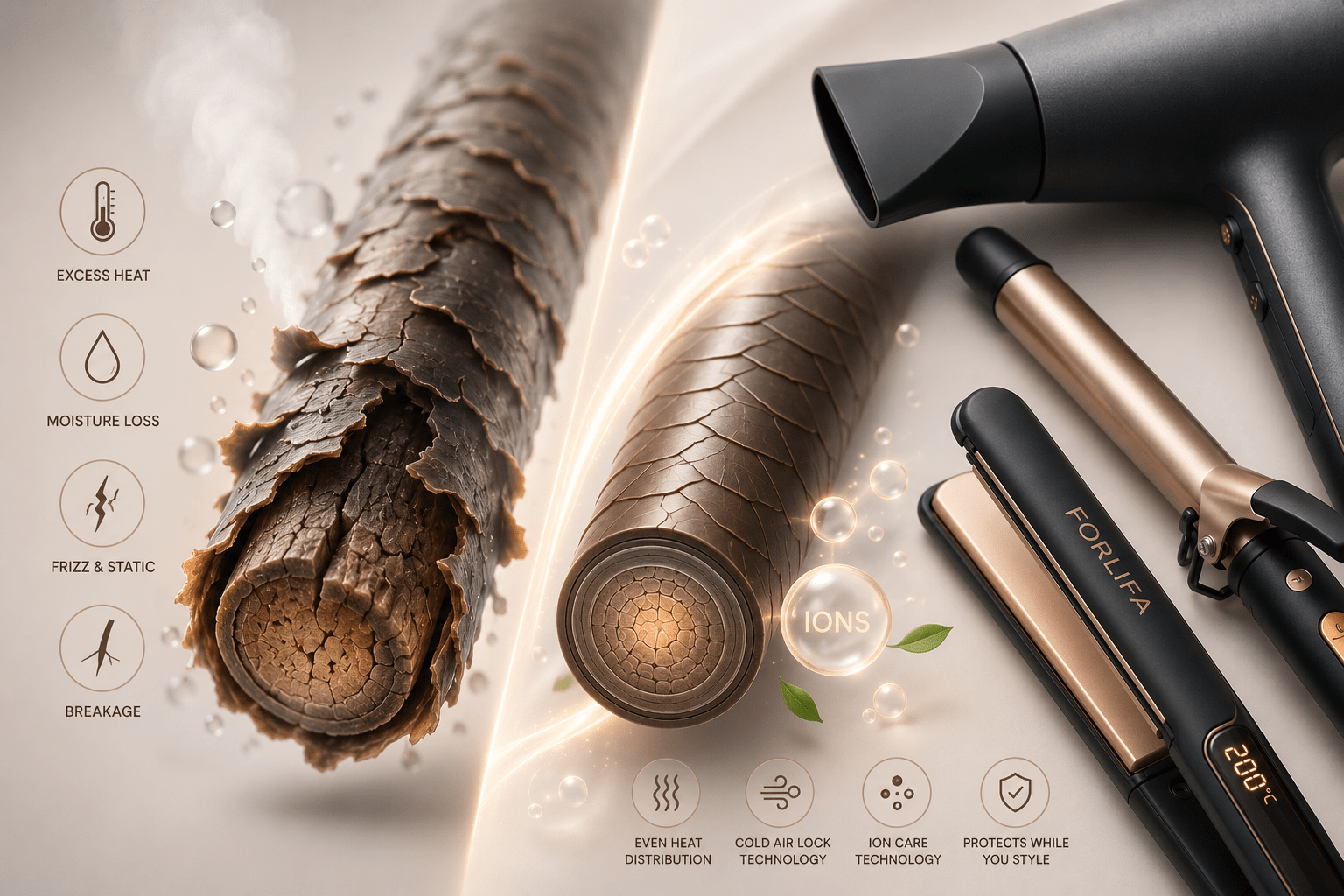
At 95°C, the picture changes substantially: dehydration becomes severe, structural embrittlement is evident, and imaging shows abundant cracks and voids. At 140°C, irreversible damage is clearly established, with scale folding and significant loss of the cell membrane complex (CMC) — the adhesive layer between cuticle cells. By approximately 200°C, progressive structural degradation has consumed the cuticle's organized architecture.^1^
What makes these thresholds more important than they first appear is their interaction with prior chemical treatment. Bleaching, dyeing, and chemical relaxing all compromise the cuticle's lipid layer (specifically an outer fatty acid called 18-MEA) and reduce disulfide bond density, increasing fiber porosity. Research indicates that previously damaged hair reaches the same levels of cuticle cracking at temperatures 20–40°C lower than undamaged hair. A flat iron setting appropriate for healthy hair is a genuinely different — and more damaging — experience for processed hair.^1^
The Cortex: Where Permanent Damage Lives
Structural changes at the cuticle surface, while significant, are often visible and motivate behavioral change. What happens in the cortex is different in character: it is less visible, more permanent, and governed by the physics of a composite material under sustained thermal load.
From a materials science perspective, the cortex behaves as a two-phase system. The reinforcing phase consists of highly ordered α-helical intermediate filaments — tightly wound protein structures that account for roughly 25–30% of the cortex volume and are responsible for the fiber's tensile strength and elastic recovery. The matrix phase consists of amorphous keratin-associated proteins (KAPs) and CMC, crosslinked by disulfide bonds, which embed and stabilize the filaments.
These two phases respond to heat differently, which is why the cortex's thermal behavior is best described as a two-stage transition rather than a single event.^4^
The glass transition zone (approximately 140–210°C) involves the matrix phase shifting from a rigid, glassy state to a more mobile, elastic state. This is the range in which effective styling happens: molecular chain segments become mobile enough to accommodate reshaping without the filament structure itself being disrupted. Applied correctly — with appropriate temperature, minimal contact time, and a single controlled pass — styling in this zone produces the desired result with manageable structural cost.
Above approximately 210°C, the ordered helical structures themselves begin to destabilize irreversibly, converting toward random coil configurations. The distinction from the glass transition zone is important: below this threshold, the matrix phase is doing the work; above it, the filaments themselves are at risk. This is why the upper temperature range in this zone should be reserved for coarse, highly resistant hair where the thermal mass of the fiber requires more energy to achieve even the initial glass transition — and used with the deliberate, time-limited technique that the science recommends.
The Cumulative Damage Problem: Why Technique Matters as Much as Temperature
One of the most practically important findings in the heat damage literature is that cortex damage follows first-order kinetics — meaning it accumulates predictably with total thermal exposure time, not just peak temperature.^4^
At 200°C, the α-helical content of the cortex decreases as a function of treatment duration following a predictable decay curve. For bleached or chemically processed hair, the data establishes a particularly significant threshold: cumulative contact time exceeding approximately 300 seconds at high temperature causes cortical proteins to convert irreversibly toward a highly crosslinked thermoset-like state. Once this transition occurs, the fiber permanently loses elasticity and becomes substantially more prone to mechanical breakage.
The 300-second figure is not a per-session limit — it is cumulative across the fiber's life from the point of chemical treatment. A strand of bleached hair that has experienced repeated styling sessions is already partway down this curve before any given session begins.
Several practical implications follow directly:
One-pass styling is structurally significant, not just efficient.
Making a single controlled pass at the correct temperature deposits less total thermal dose than two or three passes at a lower temperature attempting to achieve the same result. Tools that reach stable operating temperature quickly and distribute heat evenly across the styling surface — reducing the need for repeat passes — reduce cumulative exposure meaningfully.
Contact time and temperature are multiplicative risk factors.
A 15-second pass at 200°C is a categorically different thermal exposure than a 3-second pass at the same temperature. Timing awareness, and where available, built-in timing cues, directly address this.
Processed hair requires recalibrated settings, not just caution.
The same temperature that represents the lower end of the glass transition zone for healthy hair may be approaching the irreversible denaturation zone for bleached hair, which has fewer protective crosslinks and a compromised cuticle barrier. Graduated temperature settings matched to hair condition, rather than a single default setting for all users, reflects this reality.
Moisture Content: The Variable That Changes Everything
The denaturation temperature of keratin is not a fixed number. It is a function of the fiber's moisture content, and the difference is not marginal.
Differential scanning calorimetry (DSC) studies establish the contrast precisely: fully dry hair keratin begins to denature at approximately 230–240°C, with an activation energy of around 416 kJ/mol.^5^ Hair at normal moisture levels (10–15% water content) shows a primary denaturation peak in the range of 120–150°C — a reduction of roughly 80–100°C in the critical threshold. Water acts as a plasticizer for the protein matrix, lowering the energy barrier required to disrupt structural bonds.
The practical consequence of this is severe. Applying a flat iron or curling iron at 175°C to hair that has not been fully dried means applying heat well above the wet-state denaturation threshold. The result is not simply elevated styling risk — it creates a specific failure mode researchers call bubble hair: residual moisture within the fiber flash-vaporizes under the plate, generating internal steam pressure that physically ruptures the cortex. The resulting voids are permanent, and the hair at those points is irreversibly weakened even if the surface appears undamaged.^2^
Complete drying before high-heat contact is not a precautionary suggestion — it is a structural requirement derived from the physics of moisture-dependent protein behavior. This holds regardless of tool quality, coating type, or styling technique. No engineering feature in the tool compensates for moisture content in the fiber at the moment of contact.
Why Hair Type Changes the Risk Equation
The thresholds described above apply to hair in a baseline condition, but biological variation across hair types shifts the starting position meaningfully.
Chemically processed hair — bleached, color-treated, or relaxed — presents a compromised cuticle with lower lipid density, reduced disulfide crosslinking, and higher porosity. As noted, this shifts the effective damage threshold downward by 20–40°C. The same fiber also has lower elastic recovery from deformation, meaning mechanical stress from styling adds to thermal stress in a way that accelerates the cumulative damage kinetics.
Asian hair, which tends toward a larger fiber diameter (70–100 µm) with more cuticle layers, has greater thermal mass — more energy is required to raise the cortex temperature to the glass transition zone — but also benefits from more protective cuticle layers that slow heat penetration.^6^ The anagen phase in Asian hair can extend to seven years, meaning each individual strand accumulates more total styling cycles over its lifetime than hair with a shorter growth cycle.
Fine hair — whether by genetics or from prior damage — has a smaller cross-section, less cortex volume, and proportionally less structural reserve. It reaches styling-effective temperatures faster with less energy input, which is why fine hair categories consistently show greater heat damage per session than coarser categories at the same tool settings.
Applying the Thresholds: A Practical Summary
The research establishes a coherent set of parameters for styling that protects structural integrity:
At or below 150°C — operating at the lower edge of the glass transition zone, suitable for fine hair, previously damaged hair, or hair in early stages of processing. Heat effects are largely within the reversible-to-borderline range; technique matters but the margin for error is greater.
150–180°C — the core styling zone for healthy hair of average diameter. Effective reshaping of hydrogen bond networks occurs; one-pass technique and complete drying before styling keep cumulative exposure well within safe limits.
180–210°C — appropriate for coarse or resistant hair that requires more thermal input to reach the glass transition threshold. Demands attentive technique: single passes, adequate time between sections, and no application to any moisture-containing hair.
Above 210°C — the upper boundary where the reinforcing filament phase begins to be at risk. Where tools reach this range, contact time should be minimized, and application should be limited to genuinely coarse, resistant hair where the alternative is repeated lower-temperature passes that would accumulate greater total exposure. The absolute limit for any styling application is determined by the 237°C keratin denaturation point — no contact-heating tool should be engineered to approach this threshold.^5^
Understanding where your hair type sits on this risk curve — and adjusting temperature selection and technique accordingly — is what separates styling that serves hair health over time from styling that produces an outcome today at the cost of structural decline tomorrow.
References
1. Christian, P. (2009). Heat styling and hair structure. International Journal of Cosmetic Science, 31(5), 337–346. https://doi.org/10.1111/j.1468-2494.2009.00509.x
2. Lee, Y., Kim, Y.D., Pi, L.Q., et al. (2011). Hair shaft damage from heat and drying during hair dryer use: comparison with air drying. Annals of Dermatology, 23(4), 455–462. https://doi.org/10.5021/ad.2011.23.4.455
3. Lima, C.R.R.C., et al. (2026). Thermal effects on hair cuticle morphology under mechanical stress. Journal of Cosmetic Dermatology (advance publication). https://doi.org/10.1111/jocd.16042
4. Wortmann, F.J., Springob, C. & Sendelbach, G. (2002). Investigations of cosmetically treated human hair by DSC. Journal of Cosmetic Science, 53, 219–228. https://pubmed.ncbi.nlm.nih.gov/12151927/
5. Wortmann, F.J. & Deutz, H. (1993). Characterizing keratins with DSC. Journal of Applied Polymer Science, 48(1), 137–150. https://doi.org/10.1002/app.1993.070480116
6. Franbourg, A., Hallegot, P., Baltenneck, F., Toutain, C. & Leroy, F. (2003). Current research on ethnic hair. Journal of the American Academy of Dermatology, 48(6), S115–S119. https://doi.org/10.1067/mjd.2003.277
Part of the Forlifa Knowledge Base — a series grounded in peer-reviewed dermatology, materials science, and cosmetic science literature. See also: [Hair Structure & Biology] and [How Styling Tools Affect Your Hair].